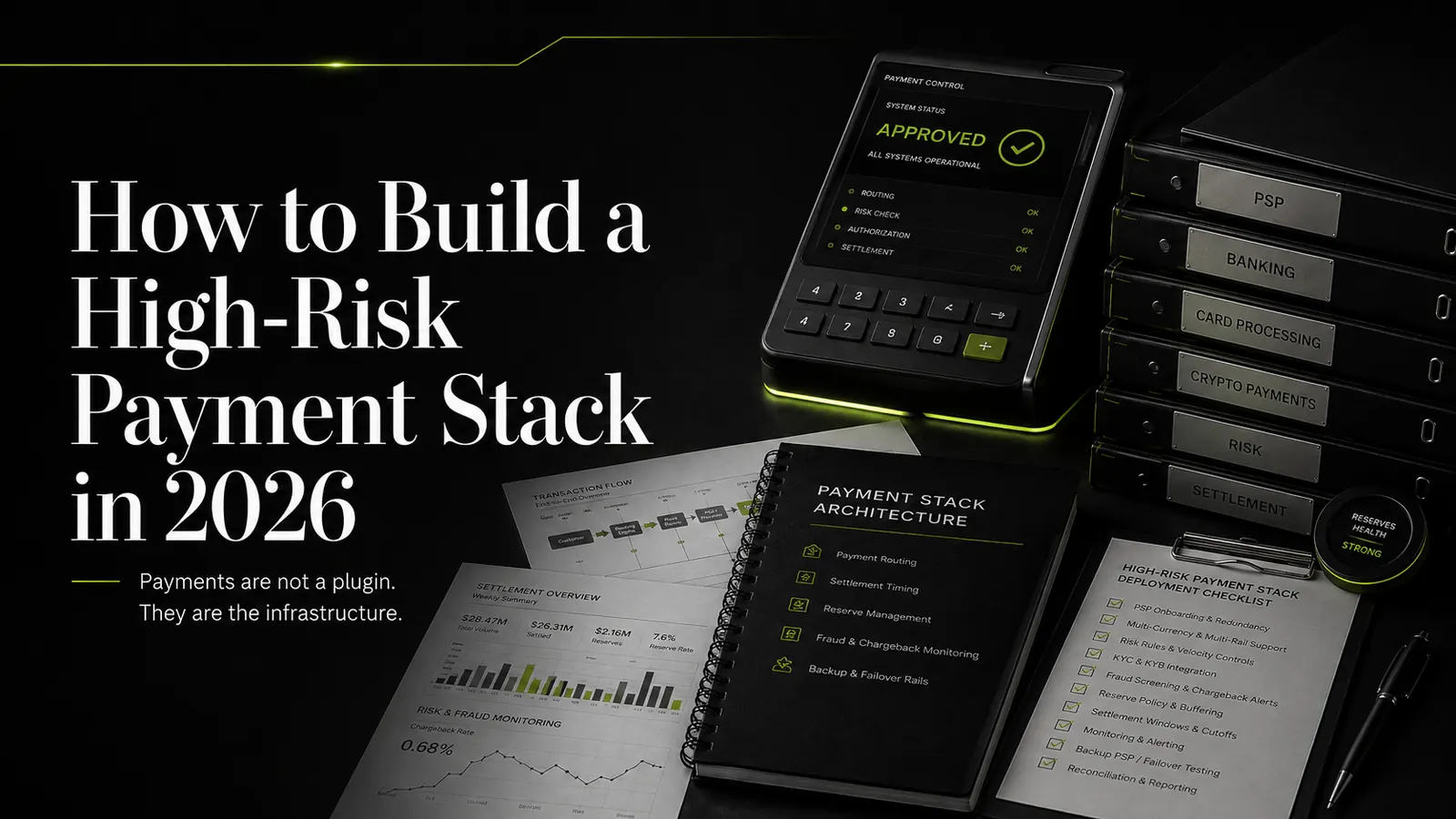
High-risk payments are not a plugin. They are the infrastructure behind how money enters the business, how funds settle, how fraud is controlled, how reserves affect cash flow, and what happens when one payment route stops working.
A high-risk payment stack is not just one PSP account. It is the full operating system behind deposits, card processing, crypto payments, banking, settlement, reserves, fraud controls, chargebacks, refunds, reporting, and backup routes.
For Forex, iGaming, crypto, Nutra, adult, affiliate-driven offers, offshore services, and other difficult-to-bank businesses, the payment stack should be planned before traffic starts.
InVault helps founders and operators think through the payment infrastructure privately. We are not a PSP, bank, public directory, marketplace, ad board, law firm, or one-size-fits-all provider list.
What changed in 2026
High-risk payments are more operational than they used to be. It is no longer enough to find one provider that says yes. Operators need to think in routes, reserves, settlement timing, backup rails, fraud controls, chargeback monitoring, banking fit, crypto settlement, traffic quality, and support ownership.
Market and standards references such as PCI SSC, Visa, Mastercard, FATF, payment-industry reporting, PSP risk guidance, and sector-specific coverage all point to the same practical reality: payment infrastructure has to be documented, monitored, and operated.
A payment stack is not one provider
A high-risk payment stack is the full system behind card processing, PSP access, banking, crypto payments, settlement, reserves, refunds, fraud controls, chargebacks, reporting, and backup routes.
Payments must be planned before traffic
Forex, iGaming, crypto, Nutra, adult, affiliate-driven, and offshore businesses should not scale traffic before payment routing, settlement, support, and risk controls are ready.
Settlement timing affects survival
A business can show revenue and still run out of usable cash if settlement is delayed, rolling reserves are high, refunds increase, or chargebacks create provider pressure.
Backup routes are not optional
One PSP, one acquiring route, one bank, or one crypto settlement path creates a weak point. A serious high-risk business needs a realistic failover plan.
Traffic quality changes payment risk
Affiliate traffic, paid media, outbound sales, call centers, and high-pressure funnels can change chargeback exposure, fraud risk, refund behavior, and provider appetite.
Operations keep the stack alive
Support, finance, compliance, traffic, sales, and management all need visibility into payment issues. Payment infrastructure is an operating discipline, not a one-time integration.
What you actually need before launch
A high-risk payment setup should not be a loose list of providers. It should be a working stack with clear ownership, documentation, backup thinking, and reporting.
Business model
Define the vertical, offer, customer type, target markets, traffic model, refund logic, support expectations, and transaction behavior before approaching PSPs or banks.
Choose PSPs and gateway partners that understand the actual vertical, can support reporting, fraud monitoring, routing, settlement visibility, and escalation under pressure.
Banking and EMI accounts
Plan where settlements land, which entity owns the account, what currencies are needed, how operating expenses are paid, and what happens if account activity increases.
Crypto payments
Use crypto rails only when they fit the customer base and operating model. Stablecoin settlement, wallet screening, accounting, refunds, treasury movement, and customer instructions still matter.
Risk and chargeback controls
Track chargebacks, fraud alerts, refund patterns, failed payments, traffic source quality, customer complaints, descriptor clarity, and support response time before providers flag the business.
Choose the right payment model
The right payment stack depends on the vertical, customer type, target market, transaction behavior, traffic source, support process, and provider appetite.
Forex and CFD brokerage
A Forex payment stack may need card processing, bank transfer, crypto deposits, CRM integration, client wallet support, withdrawal workflow, dispute monitoring, and strong settlement visibility.
The payment route should match the brokerage model: regulated, offshore, white-label, introducing broker, prop-style, or crypto/FX hybrid.
iGaming and online casino
An iGaming payment stack must handle deposits, withdrawals, KYC, fraud checks, bonus abuse, affiliate traffic, chargebacks, player support, and crypto payments where relevant.
Payment failure in iGaming damages trust quickly because players care about deposits, withdrawals, and support speed.
Crypto and Web3 business
A crypto payment stack may include stablecoin settlement, fiat on/off-ramp partners, wallet screening, custody decisions, exchange or broker flows, banking, and reporting.
Crypto payments can reduce some card-processing pressure, but they do not remove the need for structure, compliance thinking, accounting, and operational control.
Nutra and affiliate-driven offers
Nutra and performance-marketing businesses often face refund pressure, subscription confusion, delivery questions, affiliate-quality issues, chargebacks, and reserve pressure.
The payment stack has to connect billing clarity, support response, delivery evidence, affiliate controls, and chargeback monitoring.
Adult and sensitive-content businesses
Adult and sensitive-content operators may face card restrictions, bank hesitancy, content-policy review, privacy expectations, payout issues, and higher provider scrutiny.
The stack needs provider fit, backup rails, content-policy awareness, and a clear settlement process.
Step 1: define the real payment model
The first question is not which PSP can approve the business. The first question is what the business actually does, who the customer is, how the customer pays, what creates refunds, and what kind of risk the provider is being asked to support.
A Forex brokerage, online casino, crypto broker, Nutra subscription offer, adult platform, affiliate funnel, and offshore service business all create different payment pressure.
A proper high-risk payment stack starts with the business model, target markets, expected monthly volume, average transaction size, customer support model, refund policy, chargeback exposure, traffic source, and documentation quality.
Simple example
A business using SEO and warm inbound leads has a different risk profile from one using aggressive affiliates, call centers, and paid traffic. The payment stack should reflect that before traffic starts.
Step 2: separate card processing, PSPs, banking, and crypto
High-risk founders often say they need a payment provider, but that is too vague. Card processing, PSP access, gateway routing, banking, EMI accounts, settlement accounts, crypto payments, refunds, and payouts are separate parts of the stack.
Card processing solves only one part of the payment problem. A PSP may provide the interface, reporting, checkout, routing, fraud tools, and settlement reports. Banking or EMI support determines where money lands and how the business operates. Crypto payments may help in some markets but add their own risk and accounting questions.
The right approach is to map each layer separately and then connect them into one operating model.
Payment stack rule
Do not judge the stack only by whether the first provider says yes. Judge it by what happens after volume, refunds, reserves, disputes, customer questions, and settlement pressure begin.
Step 3: plan reserves and settlement timing before launch
Rolling reserves and settlement delays are not small details. They directly affect working capital and runway.
If the business processes strong volume but a percentage is held for several months, headline revenue can look good while usable cash remains tight. That matters when the business has affiliate payouts, media buying, support teams, call centers, platform fees, customer withdrawals, legal costs, and vendor payments.
A founder should model setup fees, monthly PSP fees, gateway fees, transaction fees, chargeback fees, refund volume, reserve percentage, reserve release timing, settlement delay, backup-route costs, fraud tools, and working capital buffer.
Cash-flow warning
A payment route with a higher reserve but stable settlement may be safer than a cheaper route that freezes, caps, or delays money when traffic increases.
Step 4: build fraud and chargeback monitoring into the operation
Chargebacks and fraud are not just support issues. They are payment-stack issues. Card schemes, acquirers, PSPs, and risk teams watch dispute behavior, fraud patterns, refund behavior, authorization rates, decline reasons, and customer complaints.
PCI SSC standards matter for card-data security. Visa and Mastercard monitoring programs matter for fraud and dispute behavior. FATF guidance matters where virtual assets, VASPs, stablecoins, or crypto settlement are part of the payment model.
In practice, many chargebacks come from deeper business problems: misleading traffic, weak onboarding, bad affiliate sources, poor support, confusing billing descriptors, slow withdrawals, unclear refund terms, or aggressive sales scripts.
Operational rule
Track chargebacks by source, campaign, affiliate, sales team, country, product line, and support history. If the business cannot see where disputes come from, it cannot fix the root problem.
Payment setup and traffic strategy cannot be separated. A business using affiliates, paid media, outbound sales, call centers, or high-pressure funnels may create a very different risk profile from a business using SEO, private referrals, or warm inbound leads.
Payment providers care about how customers arrive, what they are promised, what they buy, how they are charged, how quickly support answers, and whether customers later complain.
Support is part of payment risk. Slow answers, unclear refund terms, confusing onboarding, or poor withdrawal communication can turn normal customer friction into disputes.
Before scaling traffic
Traffic should scale only after deposits, refunds, settlement visibility, support scripts, chargeback alerts, and backup routes are ready. Traffic into a weak payment operation burns money and provider trust.
Step 6: prepare backup routes before something breaks
One PSP, one bank, one acquiring route, one cashier method, or one crypto settlement path is not a strategy. It is a dependency.
High-risk payment routes can be paused, capped, delayed, reviewed, restricted, or terminated. Providers can change risk appetite. Banks can ask for more documentation. Chargeback ratios can rise. A payment method can stop converting. A region can become unavailable.
A backup route is not just another provider in a spreadsheet. It needs documentation, technical readiness, volume limits, settlement expectations, support instructions, and a trigger point for when to switch traffic.
Failover rule
Backup payments should be tested while the business is calm, not when traffic is already running and customers are asking why deposits or withdrawals stopped working.
What should be in your payment stack brief before speaking to providers
Before speaking with PSPs, banks, EMI partners, crypto payment providers, gateway partners, or risk tools, the business should have a clear payment stack brief. This does not need to be a hundred-page document, but it should be specific enough that a serious provider can understand the business without guessing.
Forex operators can use the provider-ready Forex PSP brief for a vertical-specific breakdown of GEOs, FTD and retention volume, payment methods, withdrawals and settlement.
iGaming operators can use the provider-ready iGaming PSP brief for a vertical-specific breakdown of player GEOs, deposit and withdrawal methods, reserves, settlement, provider comparison, and pilot checks.
Many high-risk founders lose time because they approach providers with only a vague description: "We need card processing," "We need a PSP," or "We need crypto payments." That is not enough. Providers need to understand the model, markets, traffic, transaction behavior, support process, documentation, and risk profile before they can say whether the route is realistic.
Business and vertical
Explain what the business does, which vertical it belongs to, who the customer is, whether it is Forex, iGaming, crypto, Nutra, adult, affiliate-driven, offshore services, or another difficult-to-bank model.
Company and jurisdiction
Include the company structure, country of incorporation, operating markets, restricted markets, ownership information, and whether legal or compliance review has already been done.
Payment methods needed
List whether the business needs card processing, bank transfer, local payment methods, crypto payments, stablecoin settlement, payout support, recurring billing, or multi-currency acceptance.
Expected volume and transaction behavior
Include expected monthly volume, average transaction value, ticket range, refund expectations, chargeback history if any, settlement needs, and whether volume will grow gradually or quickly through traffic campaigns.
Traffic and acquisition sources
Explain whether customers come from SEO, paid traffic, affiliates, call centers, outbound sales, communities, private publishers, influencers, existing clients, or partner referrals.
Risk, support, and operations
Show how refunds, disputes, fraud alerts, customer support, KYC/KYB, chargebacks, reconciliation, withdrawals, and provider escalation will be handled day to day.
Why this matters
A strong brief helps InVault and any relevant provider understand whether the opportunity is a real fit. It also prevents the founder from wasting time with payment routes that look good in conversation but cannot support the actual business model once traffic, customers, settlement, reserves, refunds, and disputes begin.
How to review payment providers before you commit
A weak provider can make a good business harder than it needs to be. A strong provider does not only sell an approval. It understands the vertical, documentation, settlement pressure, reporting needs, traffic model, reserve logic, and operating reality behind the business.
Check whether the account can receive funds from PSPs or acquirers, support international transfers, handle operating expenses, and stay comfortable as activity increases.
Crypto payment provider
Check stablecoin support, wallet flow, transaction monitoring, treasury controls, customer instructions, refund logic, reporting, accounting, and fiat conversion needs.
Fraud and risk tools
Check fraud screening, velocity controls, chargeback alerts, KYC/KYB support, device signals, source monitoring, and whether the tools integrate with the team's daily process.
The business should not move into serious traffic while the payment operation is still guessing. Readiness is not perfection. It means the important questions have answers before customers, affiliates, and providers create pressure.
Payment readiness
Deposits work, refunds are mapped, settlement is visible, rolling reserves are understood, backup routes exist, and support knows how to answer payment questions.
Banking readiness
The operating account or EMI route can receive settlement, pay vendors, support refunds where needed, handle international transfers, and match the company structure.
Risk readiness
Chargebacks, fraud alerts, refunds, failed payments, customer complaints, descriptor issues, and traffic-source problems are tracked before the provider escalates them.
Operations readiness
Someone owns PSP communication, settlements, chargeback responses, reconciliation, support escalation, provider documents, and backup route activation.
A practical first 90 days
A stronger payment setup is usually staged. The goal is not to process as much as possible on day one. The goal is to build the stack, test weak points, understand early numbers, and scale only when the operation can handle more pressure.
Phase 1: payment map
Define the business model, target markets, traffic sources, payment methods, customer behavior, refund logic, settlement needs, reserve expectations, and provider categories.
Phase 2: provider review
Review PSPs, card routes, banking or EMI accounts, crypto payment providers, fraud tools, legal/compliance support, and backup routes based on fit rather than promises.
Phase 3: controlled launch
Test deposits, refunds, settlements, support scripts, reconciliation, chargeback alerts, crypto confirmations, and backup-provider readiness before major traffic starts.
Phase 4: improve and scale
Use early data to adjust routing, fraud rules, traffic sources, refund handling, support workflows, reserves, settlement planning, and provider escalation before adding volume.
Budget planning: do not ignore reserves and settlement delays
There is no honest universal price for building a high-risk payment stack. The budget depends on vertical, structure, target market, provider requirements, reserve terms, settlement timing, transaction volume, risk tools, banking needs, crypto rails, and working capital.
Provider setup and monthly fees
PSP onboarding, gateway fees, account fees, minimum monthly costs, integration costs, and provider deposits where applicable.
Transaction and processing costs
Card fees, gateway fees, decline costs where relevant, crypto payment fees, bank transfer costs, FX costs, and local payment method costs.
Reserves and settlement delay
Rolling reserves, reserve release timing, settlement windows, cash held by providers, and the working capital needed to operate while funds are delayed.
Fraud and chargeback management
Chargeback fees, refund exposure, fraud tools, monitoring software, dispute-response process, and operational time spent managing payment risk.
Banking and crypto operations
EMI or banking setup, international transfers, stablecoin settlement, wallet screening, treasury movement, fiat conversion, accounting, and reporting.
Backup route cost
Secondary PSPs, backup banking, emergency routing, technical integration, provider documentation, and the cost of keeping alternatives ready.
A founder should not ask only, "Who can process us?" The better question is, "What payment infrastructure can survive our business model after real traffic starts?"
Common mistakes when building a high-risk payment stack
Most payment mistakes are not mysterious. They come from building in the wrong order, trusting weak routes, ignoring cash-flow pressure, or treating payments like a checkout button instead of an operating system.
Choosing a PSP before the business model, traffic source, jurisdiction, and customer profile are clear.
Treating payment approval as success instead of the beginning of monitoring.
Ignoring rolling reserves and settlement delays until cash is already tight.
Scaling paid traffic before deposits, refunds, settlements, and support workflows are tested.
Using one provider with no backup route, no escalation path, and no emergency plan.
Adding crypto payments without stablecoin planning, wallet screening, accounting, or customer instructions.
Not tracking chargebacks by traffic source, affiliate, campaign, sales team, country, or product line.
Letting sales, traffic, support, finance, and payments operate separately when they should share risk signals.
The fix is order. Define the model. Check structure. Map payment methods. Review providers. Understand reserves. Test settlement. Prepare support. Track disputes. Add backup routes before they are needed.
How InVault fits
InVault connects serious founders, operators, and providers through a private setup process for high-risk industries. For payment stack setup, that can mean helping you think through PSPs, card processing, banking, crypto payments, settlement, reserves, fraud controls, chargeback exposure, traffic quality, legal and compliance support, hiring, and operations.
We do not publish provider details like a public directory, sell visibility like an ad board, or pretend every provider is right for every operator. The point is fit. The right payment stack depends on business model, jurisdiction, payment needs, traffic plan, operational capacity, budget, and provider quality.
References used by name
The article does not link out to external sources, but the payment and compliance context is based on public standards, monitoring programs, market reporting, and industry guidance from the following names:
PCI SSC standards and PCI DSS security guidance themes
Visa fraud and dispute monitoring program themes
Mastercard chargeback and merchant monitoring program themes
FATF guidance themes around virtual assets, VASPs, customer due diligence, and AML/CFT controls
PSP and payment-industry guidance from names such as Stripe, Checkout.com, Braintree, Worldpay, Nuvei, and similar payment providers
Specialist coverage around high-risk payments, settlement, reserves, chargebacks, fraud, crypto settlement, and merchant risk
Related setup guides
These guides go deeper into the payment, banking, crypto, Forex, iGaming, and high-risk setup pieces connected to this topic.
These resource pages cover the wider high-risk setup, payments, Forex, iGaming, crypto, and business setup thinking around this kind of infrastructure.
A high-risk payment stack is the full set of providers, accounts, payment methods, controls, reporting, and operating processes that allow a high-risk business to accept, settle, refund, monitor, and manage payments.
Is a PSP enough for a high-risk business?
Usually not. A PSP may be one part of the stack, but the business may also need banking, EMI accounts, card processing, crypto payments, fraud controls, chargeback handling, backup routes, settlement planning, and reconciliation.
Why do high-risk businesses need backup payment routes?
High-risk payment routes can be paused, capped, reviewed, delayed, or terminated. A backup route helps reduce dependency on one provider and gives the business a contingency plan.
Are crypto payments a good solution for high-risk businesses?
Crypto payments can be useful for some business models and customer bases, but they are not a universal solution. They still require structure, reporting, risk screening, support processes, accounting, and jurisdiction awareness.
What is a rolling reserve?
A rolling reserve is a percentage of processed funds held by a payment provider or acquiring bank for a period of time to cover possible refunds, chargebacks, fraud, or other exposure.
Why does settlement timing matter?
Settlement timing affects cash flow. If funds are delayed or held in reserve, the business may struggle to pay affiliates, media buyers, support teams, vendors, customer withdrawals, or operating costs even when revenue appears strong.
What causes high-risk payment accounts to fail?
Common causes include high chargebacks, fraud, weak documentation, misleading traffic, poor support, unclear refund terms, unsupported geographies, sudden volume spikes, risky affiliates, and mismatched provider expectations.
Can InVault help with payment stack setup?
InVault can review the business model and help identify relevant trusted partners where there is a real fit. Payment introductions are handled privately and depend on the business stage, vertical, target markets, documentation, and risk profile.
Need help building the right payment stack?
Tell us what you are building, where you want to operate, what payment routes you need, and what you already have. InVault will review the situation privately and help you understand which missing pieces need to be solved before launch or scale.